IOWA VALLEY COMMUNITY COLLEGE DISTRICT
MARSHALLTOWN COMMUNITY COLLEGE (MCC)PRINCIPLES OF ASTRONOMY COURSE NUMBER: PHS 142 M01 COURSE TITLE: Principles of Astronomy COURSE MEETING, DATES & TIMES: Monday Evenings 6-9 PM, Jan 13, 2014 --> May 5, 2014 DEPARTMENT: Math & Science Division SEMESTER CREDIT HOURS: 3 REQUIRED MATERIALS Textbook: Astronomy: Journey To The Cosmic Frontier, 6th ed by John D. Fix ISBN: 978-0-07-351218-1 Planisphere: Planisphere 42° North ISBN 978-1-55297-853-5, or Planisphere for iPad: https://itunes.apple.com/us/app/id517591777 If you do not have internet access at home, make sure to use the computer capabilities at the college. Internet Resources (and interactive syllabus): http://edu-observatory.org/mcc/syllabus/index.html http://www.wolframalpha.com Algebra Primer College Algebra Tutorial INSTRUCTOR: Sam Wormley HOME PHONE: 515 296-2627 E-MAIL: sam.wormley@gmail.com BUILDING/OFFICE: Room 516 DATE SYLLABUS WAS COMPLETED: Dec 12, 2013 DATE SYLLABUS LAST REVIEWED: Dec 12, 2013 COURSE DESCRIPTION & OBJECTIVES: John D. Fix, author of your textbook, writes in the preface of an earlier edition of your textbook: "The book provides a complete description of current astronomical knowledge, neither at an extremely technical level nor at a level that fails to communicate the quantitative nature of physical science". Understanding the world about us is a life-long pursuit. Learning is one of the most precious things that happens to you in life. In this class, not only are you introduced to a complete description of current astronomical knowledge, but you also learn how to be a better lifelong learner. Emphasis is on principles of how the things work in the universe as opposed to memorizing a bunch of facts or numbers that you could easily look up. Principles of physics here on the Earth are the same as "out there" at planets, stars and galaxies! When you look out on a clear dark night, away from city lights, you are looking out into the Universe. This course will help you to make connections between what you see and some basic physical principles which govern the world and the Universe that you are a part of. Almost all hydrogen atoms in your body (after all you are about 90% water) are 13.7 billion years old! Hydrogen was created by the Big Bang. Carbon, the basis of organic life, the Iron in your blood, Iodine and heavier elements necessary for life, were forged in the fiery cores of stars and supernovae explosions eons ago and then swept up from interstellar space 4.56 billion years ago when the solar system formed. This course will help you connect with the Universe, of which you are, indeed, an integral part! Our textbook is your primary source of information. There will be much supplementary material (stories, films, dialogue) presented and occasional observing outside on the MCC campus. The most valuable aspect of the contact time in the classroom is dialoguing with your instructor--gaining answers and insight to your questions. Your active participation in the learning process is essential. It is you who do the learning. The instructor merely assists you. PREREQUISITES: Need Algebra CO-REQUISITE: None QUALITY STANDARD: This course is taught to a standard meeting and exceeding that required to transfer credit to the Regents Universities of Iowa and other colleges and universities. PERFORMANCE STANDARDS AND ASSIGNMENT MATRIX:
COURSE SYLLABUS
http://edu-observatory.org/mcc/syllabus
Spring 2014
RM 516
| Date | Class Participation | Homework Assignment Due | Take Home Exams |
| 1/3 of grade | 1/3 of grade | 1/3 of grade | |
| 1-13 | Required | ||
| 1-27 | Required | Required (Ch. 1-3) | |
| 2-03 | Required | Required (Ch. 4-5) | |
| 2-10 | Required | Required (Ch. 6-7) | |
| 2-17 | Required | Required (Ch. 8-9) | Handout Midterm |
| 2-24 | Required | Required (Ch. 10-11) | | |
| 3-03 | Required | Required (Ch. 12-13) | Midterm Due |
| 3-10 | Required | Required (Ch. 14-15) | |
| 3-24 | Required | Required (Ch. 16-17) | |
| 3-31 | Required | Required (Ch. 18-19) | |
| 4-07 | Required | Required (Ch. 20-21) | |
| 4-14 | Required | Required (Ch. 22-23) | Handout Final |
| 4-21 | Required | Required (Ch. 24-25) | | |
| 4-28 | Required | Required (Ch. 26-27) | | |
| 5-05 | Required | Outstading Homework Due | Final Due |
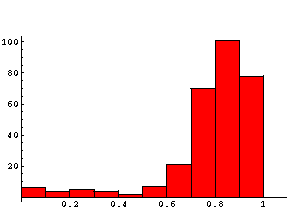 A = .900 - .999
B = .800 - .899
C = .700 - .799
D = .600 - .699
F = below .600
METHOD OF INSTRUCTION: Your instructor's primary goal is to
assist you in learning astronomy. You must take the responsibility to
attend class, read the textbook, do the homework and take the exams.
Your instructor is there to help you with the learning--Answering
questions, clarifying concepts, presenting lecture materials, readings,
homework and guiding observations.
EVALUATION/CLASS POLICIES:
Academic Integrity: The very nature of higher education requires that
students adhere to accepted standards of academic integrity. The Code of
Academic Conduct for Iowa Valley Community College District is found in
the Student Handbook Violations include cheating, plagiarism, and
fabrication, abuse of academic materials, complicity in academic
dishonesty, falsification of records and official documents.
Plagiarism/academic dishonesty: is a serious violation of MCC's Student
Conduct Code. Instructors handle violations in various ways, but you
should be aware that further administrative disciplinary actions may be
taken, up to and including course failure and expulsion from college.
Please learn about plagiarism and how to properly cite others work.
Consequences: can include a reduction in course grade, failure to pass
the course, and dismissal from the college.
Please refer to student handbook and the college catalog for all
in-depth college policies and procedures which are available on the
MCC website.
SMOKEFREE AIR ACT: IVCCD complies with Iowa's Smokefree Air Act of 2008.
In conjunction with this, the IVCCD Board of Directors prohibits the use
of tobacco in any form on its grounds or in any of its facilities or
vehicles. This includes personal vehicles owned or operated by students
while on school grounds. Civil penalties can be assessed to those found in
violation of this regulation. To register a complaint, contact a District
official or the Iowa Department of Public Health at 1-888-944-2247 or visit
www.IowaSmokefreeAir.gov.
DISABILITIES STATEMENT: Iowa Valley Community College District
(IVCCD) understands its responsibility under the Americans with
Disabilities Act (ADA) to make reasonable accommodations for students
with disabilities. Please contact Martha Schwandt (641-752-7106, ext 5769
or Martha.Schwandt@iavalley.edu) if you have a physical or mental
impairment that substantially limits learning and a record of such
impairment or are regarded as having such impairment.
SUCCESS CENTER (rooms 410 and 412) is designed to provide additional
support for students who need help reaching their academic goals. The
Success Center provides peer tutoring at no cost to the student, and
non-transferable, institutional credit courses in reading, math,
vocabulary, and spelling improvement. In addition, computers, math and
writing assistance are available. The Success Center is open from 8 AM
to 4 PM daily.
DROP/ADD POLICY: If the change (adding or dropping a class,
changing from credit to audit or audit to credit) is made within the
first 5 days of a full, 16-week semester, there is no charge for making
a change. Changes made during and after the second week of a full,
16-week semester (or the first day of a summer session course) will be
listed on the student's transcript with the grade "W" (withdrew).
Charges are assessed for changes in registration after the first five
days of classes during a full, 16-week semester (second week of class).
Charges for withdrawal during summer, special sessions, or condensed
sessions will be charged as of the second day of class. Failure to
"change registration" officially in the Registrar's Office will result
in a grade of "F" recorded on the student's transcript for that class or
classes. Refunds are based upon the date of "official withdraw" from
classes, not upon the last date of attendance. Additional information
regarding refunds of tuition after dropping classes and the actual
refund schedule can be found under "Tuition Refund Policy" in the
catalog.
COURSE WITHDRAWAL POLICY: To "officially withdraw" from one or
more courses without academic penalty, a student must submit a drop/add
form to the Registrar's Office located in Student Services. A $5 service
fee is assessed for individual course withdrawals. A student who stops
going to class without officially withdrawing will earn an "F."
COURSE ASSIGNMENTS: We will cover 2-3 chapters of the textbook
per week. Class contact time will include asking and answering
questions concerning the textbook material, presenting supplementary
material, and occasional observing outside on the MCC campus.
You must take the responsibility to attend every class, read the
textbook, do the homework, take the exams and ask questions.
Your instructor is here to help you with the learning--Answering
questions, clarifying concepts, presenting lecture materials, readings,
homework and guiding observations.
Homework assignments (handed out during each class) are due at the
beginning of the class date for which they are assigned. Allow enough
time (roughly two hours outside of class for every hour in class) to
read the textbook chapters and do homework. At the end of each chapter
are typically found:
Chapter Summary
Key Terms
Conceptual Questions
Problems
Figure-Based Questions
Planetarium Activity
For More Information (Further Readings)
Suggestion: Read the chapter Summary at the end of each chapter
first, then read each chapter completely. It is essential that you read
each chapter assigned as you will be tested over this material.
Take notes about anything you don't understand and ask questions in
class. Going over the Conceptual Questions at the end of each chapter
is excellent preparation and lets you know if you are understanding the
material. Write down and ask questions!
A = .900 - .999
B = .800 - .899
C = .700 - .799
D = .600 - .699
F = below .600
METHOD OF INSTRUCTION: Your instructor's primary goal is to
assist you in learning astronomy. You must take the responsibility to
attend class, read the textbook, do the homework and take the exams.
Your instructor is there to help you with the learning--Answering
questions, clarifying concepts, presenting lecture materials, readings,
homework and guiding observations.
EVALUATION/CLASS POLICIES:
Academic Integrity: The very nature of higher education requires that
students adhere to accepted standards of academic integrity. The Code of
Academic Conduct for Iowa Valley Community College District is found in
the Student Handbook Violations include cheating, plagiarism, and
fabrication, abuse of academic materials, complicity in academic
dishonesty, falsification of records and official documents.
Plagiarism/academic dishonesty: is a serious violation of MCC's Student
Conduct Code. Instructors handle violations in various ways, but you
should be aware that further administrative disciplinary actions may be
taken, up to and including course failure and expulsion from college.
Please learn about plagiarism and how to properly cite others work.
Consequences: can include a reduction in course grade, failure to pass
the course, and dismissal from the college.
Please refer to student handbook and the college catalog for all
in-depth college policies and procedures which are available on the
MCC website.
SMOKEFREE AIR ACT: IVCCD complies with Iowa's Smokefree Air Act of 2008.
In conjunction with this, the IVCCD Board of Directors prohibits the use
of tobacco in any form on its grounds or in any of its facilities or
vehicles. This includes personal vehicles owned or operated by students
while on school grounds. Civil penalties can be assessed to those found in
violation of this regulation. To register a complaint, contact a District
official or the Iowa Department of Public Health at 1-888-944-2247 or visit
www.IowaSmokefreeAir.gov.
DISABILITIES STATEMENT: Iowa Valley Community College District
(IVCCD) understands its responsibility under the Americans with
Disabilities Act (ADA) to make reasonable accommodations for students
with disabilities. Please contact Martha Schwandt (641-752-7106, ext 5769
or Martha.Schwandt@iavalley.edu) if you have a physical or mental
impairment that substantially limits learning and a record of such
impairment or are regarded as having such impairment.
SUCCESS CENTER (rooms 410 and 412) is designed to provide additional
support for students who need help reaching their academic goals. The
Success Center provides peer tutoring at no cost to the student, and
non-transferable, institutional credit courses in reading, math,
vocabulary, and spelling improvement. In addition, computers, math and
writing assistance are available. The Success Center is open from 8 AM
to 4 PM daily.
DROP/ADD POLICY: If the change (adding or dropping a class,
changing from credit to audit or audit to credit) is made within the
first 5 days of a full, 16-week semester, there is no charge for making
a change. Changes made during and after the second week of a full,
16-week semester (or the first day of a summer session course) will be
listed on the student's transcript with the grade "W" (withdrew).
Charges are assessed for changes in registration after the first five
days of classes during a full, 16-week semester (second week of class).
Charges for withdrawal during summer, special sessions, or condensed
sessions will be charged as of the second day of class. Failure to
"change registration" officially in the Registrar's Office will result
in a grade of "F" recorded on the student's transcript for that class or
classes. Refunds are based upon the date of "official withdraw" from
classes, not upon the last date of attendance. Additional information
regarding refunds of tuition after dropping classes and the actual
refund schedule can be found under "Tuition Refund Policy" in the
catalog.
COURSE WITHDRAWAL POLICY: To "officially withdraw" from one or
more courses without academic penalty, a student must submit a drop/add
form to the Registrar's Office located in Student Services. A $5 service
fee is assessed for individual course withdrawals. A student who stops
going to class without officially withdrawing will earn an "F."
COURSE ASSIGNMENTS: We will cover 2-3 chapters of the textbook
per week. Class contact time will include asking and answering
questions concerning the textbook material, presenting supplementary
material, and occasional observing outside on the MCC campus.
You must take the responsibility to attend every class, read the
textbook, do the homework, take the exams and ask questions.
Your instructor is here to help you with the learning--Answering
questions, clarifying concepts, presenting lecture materials, readings,
homework and guiding observations.
Homework assignments (handed out during each class) are due at the
beginning of the class date for which they are assigned. Allow enough
time (roughly two hours outside of class for every hour in class) to
read the textbook chapters and do homework. At the end of each chapter
are typically found:
Chapter Summary
Key Terms
Conceptual Questions
Problems
Figure-Based Questions
Planetarium Activity
For More Information (Further Readings)
Suggestion: Read the chapter Summary at the end of each chapter
first, then read each chapter completely. It is essential that you read
each chapter assigned as you will be tested over this material.
Take notes about anything you don't understand and ask questions in
class. Going over the Conceptual Questions at the end of each chapter
is excellent preparation and lets you know if you are understanding the
material. Write down and ask questions!
COURSE SCHEDULE: Jan 13 Introductions Getting Started Harmony of the Worlds, Cosmos-3 (1 hr) Harmony of the Worlds, Cosmos-3 Notes Jan 27 Homework Assignment Due - Fix, Chapters 1-3 Chapter 1 -- Journey's Start Chapter 2 -- Patterns in the Sky Chapter 3 -- Ancient Astronomy Kepler's Three Laws - MU-21 (1/2 hr) The Kepler Problem - MU-22 (1/2 hr) Feb 03 Homework Assignment Due - Fix, Chapters 4-5 Chapter 4 -- Renaissance Astronomy Chapter 5 -- Gravity and Motion Inertia (Galileo) - MU-4 (1/2 hr) Kepler to Einstein - MU-25 (1/2 hr) Feb 10 Homework Assignment Due - Fix, Chapters 6-7 Chapter 6 -- Light & Telescopes Chapter 7 -- Overview Solar System Hunting the Edge of Space: Part 1 - Nova (1 hr) Feb 17 Homework Assignment Due - Fix, Chapters 8-9 Chapter 8 -- The Earth Chapter 9 -- The Moon Nova: To The Moon (1-1.5 hr) Feb 24 Homework Assignment Due - Fix, Chapters 10-11 Chapter 10 -- Mercury & Venus Chapter 11 -- Mars Is There Life on Mars? - Nova (1.2 hr) Mar 03 Homework Assignment Due - Fix, Chapters 12-13 Chapter 12 -- Jupiter & Saturn Chapter 13 -- The Outer Planets Mid-term Exam Due Voyage to the Mystery Moon - Nova (1 hr) Mar 10 Homework Assignment Due - Fix, Chapters 14-15 Chapter 14 -- Satellites [Moons] Chapter 15 -- Solar System Debris Asteroid: Doomsday or Payday? - Nova (1 hr) Mar 24 Homework Assignment Due - Fix, Chapters 16-17 Chapter 16 -- Basic Properties Stars Chapter 17 -- The Sun Secrets of the Sun - Nova (1 hr) Mar 31 Homework Assignment Due - Fix, Chapters 18-19 Chapter 18 -- The Formation of Stars and Planets Chapter 19 -- The Evolution of Stars Mysteries of Deep Space: To the Edge of the Universe - Nova (1 hr) Apr 07 Homework Assignment Due - Fix, Chapters 20-21 Chapter 20 -- White Dwarfs, Neutron Stars, and Black Holes Chapter 21 -- Binary Star Systems Mysteries of Deep Space: Exploding Stars and Black Holes - Nova (10 min) Monster of the Milky Way - Nova (1 hr) Apr 14 Homework Assignment Due - Fix, Chapters 22-23 Chapter 22 -- The Milky Way Chapter 23 -- Galaxies Runaway Universe - Nova (1 hr) Apr 21 Homework Assignment Due - Fix, Chapters 24-25 Chapter 24 -- Quasars and Other Active Galaxies Chapter 25 -- Galaxy Clusters and the Structure of the Universe Origins: Back to the Beginning - Nova (1 hr) Hunting the Edge of Space: Part 2 - Nova (1 hr) Apr 28 Homework Assignment Due - Fix, Chapters 26-27 Chapter 26 -- Cosmology Chapter 27 -- Life in the Universe Origins: Earth is Born - Nova (1 hr) Life Beyond Earth - Ferris (1 hr) May 05 Wrapping Things Up Final Exam Due CONTACT - for Carl Sagan (~2:30 hr)