Mike Meetz and Sam Wormley team up to provide a lively
discussion with OLLI members about science in the news. A
deep understanding of science is not required to share and
discuss recent Science in the News. Past Classes.
⓵ Physics - Tiny Particles Charge Like Capacitors
https://physics.aps.org/articles/v19/143
Granular particles in volcanic ash plumes or in industrial
powders often become electrified through triboelectric
charging—the direct transfer of charge from one surface to
another. Studying this process in more detail, a research
team has now increased the precision of a previously
developed technique for measuring the charge transfer
between two particles forced to collide repeatedly.
The team showed that a previously proposed theory that
treats the pair like a capacitor—a standard electronic
circuit element—fits the data well. The researchers found
that the charging process follows a consistent pattern over
many collisions, information that they hope will lead to
improved modeling of charging in complex real-world
settings.
⓶ OpenAI just scooped human researchers on a million-dollar
quantum math problem | Scientific American
https://www.scientificamerican.com/article/openai-just-scooped-human-researchers-on-a-million-dollar-quantum-math-problem/?_kx=ZvcgIhAxg-V9jkMXC8_5cTAFSeLUPkHpGsV_aYiHfRo.WEer5A
The new proof also scoops the work of two human
mathematicians, one of whom just happens to be employed by
OpenAI’s rival Anthropic. The duo—Anthropic’s Levent Alpöge
and Ethan Sussman, a mathematician at Northwestern
University—had publicly disclosed their progress on their
own independent proof in the weeks leading up to OpenAI’s
historic announcement.
“I’m not going to say that I’m not disappointed,” Sussman
says. He and Alpöge first revealed their burgeoning
collaboration to the world on October 6. Notably, the pair
updated their public GitHub repository with a new set of
intermediate results the night before OpenAI’s announcement.
“I think we were on the way and maybe even as close as a few
weeks away,” Sussman says.
“This is a major advance,” says Michael R. Douglas, a
theoretical physicist and artificial intelligence proponent
at Harvard University. “Mathematicians have been trying to
make quantum field theory rigorous for over 50 years and
have made steady progress, but real-world theories like
quantum chromodynamics always seemed out of reach—until now.
This is just the start..., but we can hope for rapid
progress.”
Both camps were pursuing something known as the Yang-Mills
problem, which concerns the math that underpins modern
physics. The “Standard Model” of particle physics explains
all the known forces in the universe with 17 interacting
particles. The particles are described by “quantum fields,”
mathematical entities that permeate all of space and time,
determining how, when and where particles appear in the
world, what they are and what they do.
But the math of quantum fields is notoriously gnarly.
Physicists use it to reliably predict what happens when they
smash particles together at places such as the Large Hadron
Collider, but mathematicians worry that the theory has
holes.
The Yang-Mills problem is about putting that theory on a
solid mathematical footing. The problem has two parts:
proving that the theory is mathematically consistent—that it
“exists”—and proving that it has a nonzero quantity called a
“mass gap,” which has important consequences in the physical
world.
——————————
The Yang–Mills theory is the framework behind the Standard
Model’s nuclear forces. Physicists use it constantly, but it
has never been built as a rigorous mathematical object in
four-dimensional spacetime. The problem has two parts:
1. Existence: For any compact simple gauge group (such as
SU(3), the group of the strong force), prove that a quantum
Yang–Mills theory exists on 4D spacetime and meets the
standard axioms of quantum field theory (Wightman or
Osterwalder–Schrader).
2. Mass gap: Prove that the lightest particle in that theory
has strictly positive mass. In other words, there is a gap Δ > 0
between the vacuum and the lowest excitation.
⓷ Why Do Some People Get Fevers After Vaccines? Scientists
May Have Found the Answer
https://scitechdaily.com/why-do-some-people-get-fevers-after-vaccines-scientists-may-have-found-the-answer/
Two people can receive the same vaccine and have very
different experiences. One develops a fever and feels
miserable for a day, while the other barely notices
anything. Scientists have long sought to understand why
these reactions vary so widely, and new research suggests
that part of the answer may lie in the trillions of microbes
living in our intestines.
An international research team found that people who
developed stronger fevers after vaccination already showed
signs of heightened inflammation and distinctive gut
microbial activity before receiving their shots. When
researchers transferred their gut microbes into mice, the
animals also developed stronger inflammatory responses to
vaccination. The findings point to a bacterial protein
called flagellin as a possible contributor and raise
intriguing questions about whether diet could influence how
the body responds to vaccines.
⓸ Bacteria discovered to be synthesising metal-organic
frameworks with 'extraordinary conductivity' | Research | Chemistry World
https://www.chemistryworld.com/news/bacteria-discovered-to-be-synthesising-metal-organic-frameworks-with-
extraordinary-conductivity/4024399.article
Bacteria may have been synthesising metal–organic frameworks
for 600 million years and no one’s noticed until now
For the first time, researchers have discovered living
creatures that make their own MOFs - metal-organic
frameworks - with exceptional conductivity. Chemists Susumu
Kitagawa, Richard Robson and Omar Yaghi won the Nobel Prize
in Chemistry last year for their work on synthetic MOFS.
Candidatus Electrothrix gigas is relatively huge — up to 8
um long — and appears to produce centimetre-long filaments
of a nickel-based MOF that help it to access energy and
electron sources in the sediment of the seafloor.
——————————
Water, water, everywhere (from Air using metal-organic frameworks)
http://edu-observatory.org/olli/Water/index.html
⓹ Scientists Develop a Clever New Way To Kill Cancer Cells
From the Inside
https://scitechdaily.com/scientists-develop-a-clever-new-way-to-kill-cancer-cells-from-the-inside/
Scientists in Japan have developed an experimental method
that uses a chemical produced by cancer cells to manufacture
anticancer drugs directly inside them. The approach relies
on carbon monoxide, a toxic gas that certain tumors produce
in unusually high amounts, to activate a chemical reaction
designed to destroy cancer cells while limiting damage to
healthy tissue.
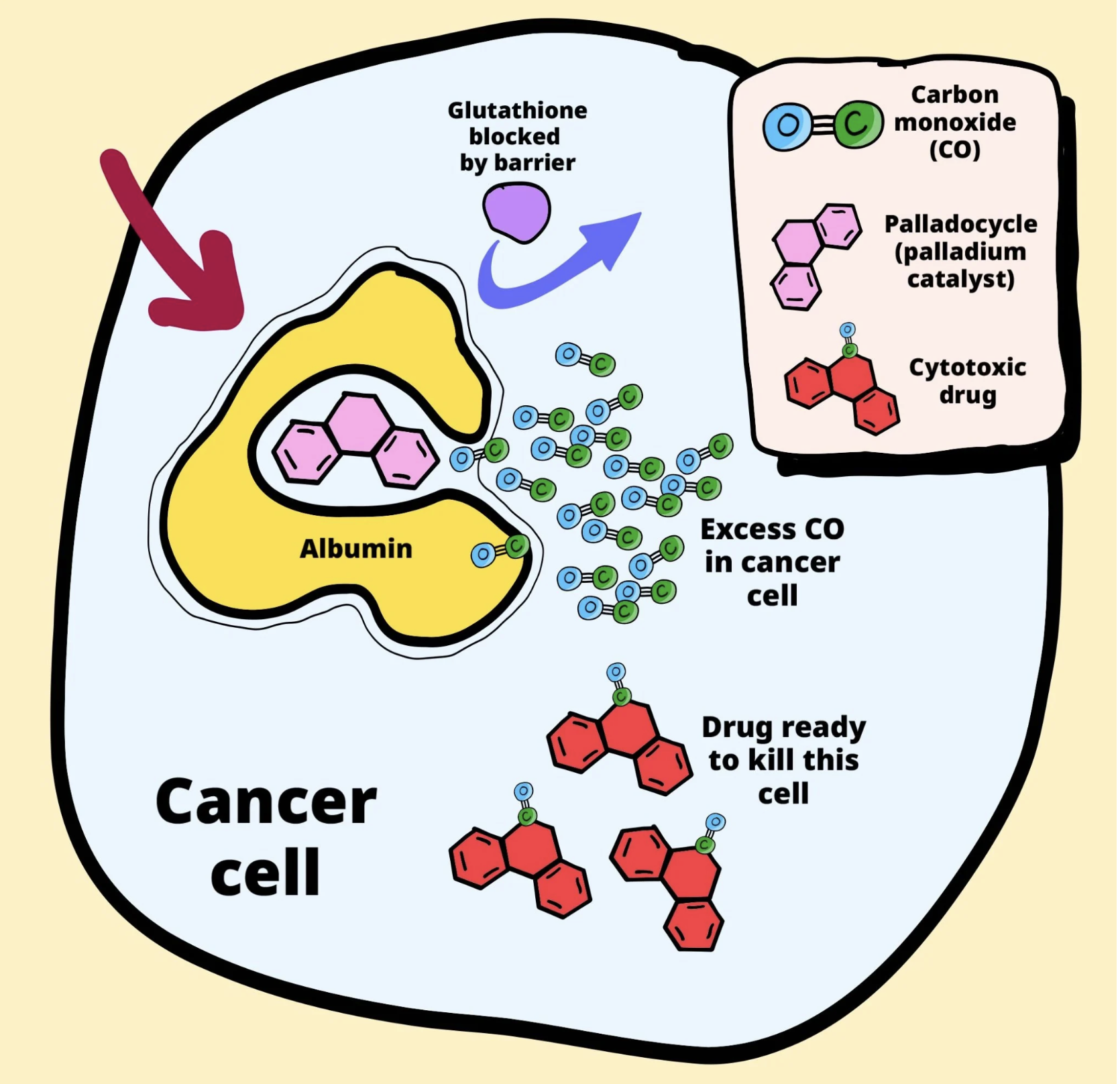 This study's major achievement. After sending the
albumin-palladocycle complex into cancer cells, the albumin
was able to protect the palladium catalyst from glutathione.
This allowed the catalyst to remain viable, and excess
carbon monoxide within cancer cells could then be used to
produce the drug, which was then freed up to kill the cancer
cells.
Cancer Cells Produce the Drug Compounds
Following 48 hours of incubation, the researchers detected
the intended phenanthridinone product in all four cancer
cell lines but not in the noncancerous cells. The results
indicated that the protected catalyst remained functional
and that the reaction depended on chemical conditions
associated with the cancer cells.
⓺ APOD | Dark Matter in a Simulated Universe
https://science.nasa.gov/image-article/apod-2026-october-25-dark-matter-in-a-simulated-universe/
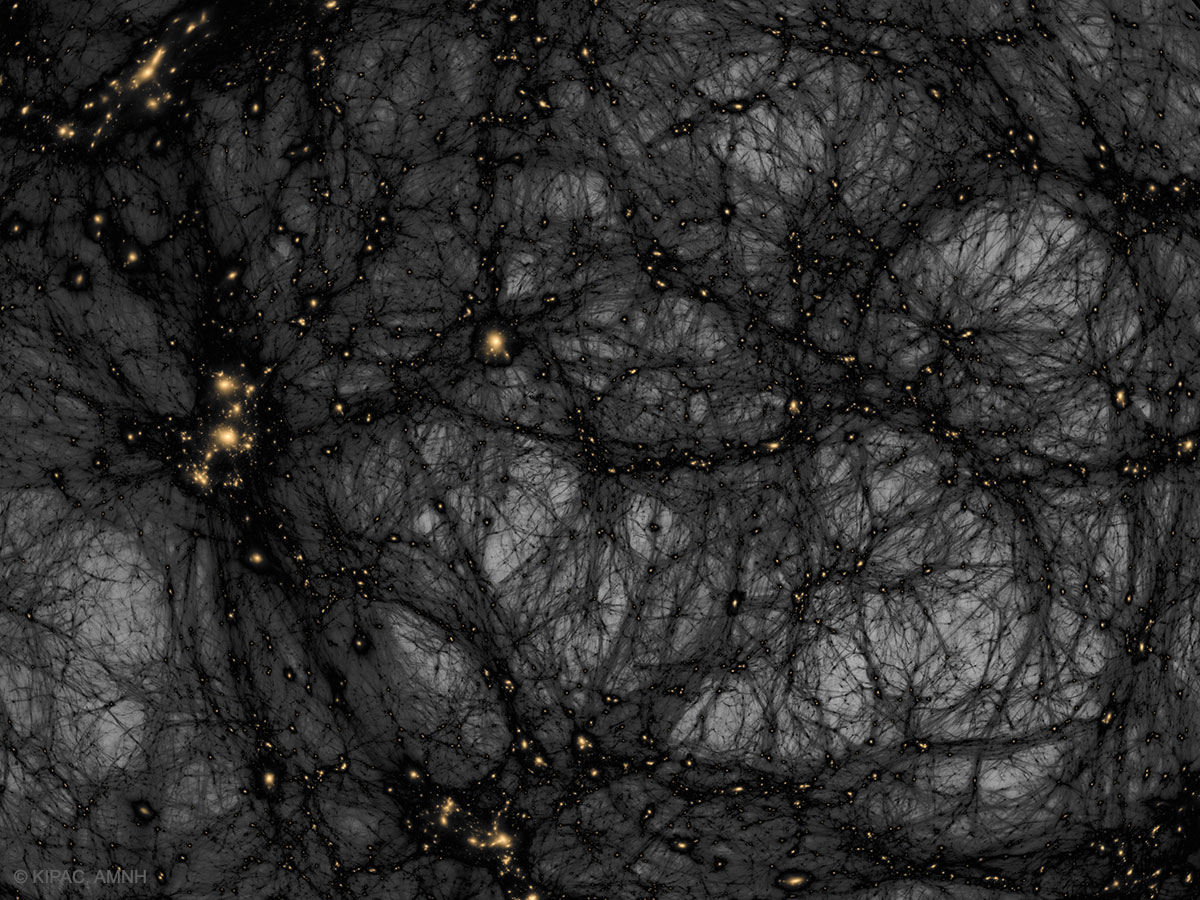 Explanation: Is our universe haunted? It might look that way
on this dark matter map. The gravity of unseen dark matter
is the leading explanation for why galaxies rotate so fast,
why galaxies orbit clusters so fast, why gravitational
lenses so strongly deflect light, and how visible matter is
distributed.
In this frame from a detailed computer simulation, complex
filaments of dark matter, shown in black, are strewn about
the universe like spider webs, while the relatively rare
clumps of familiar baryonic matter are colored orange. These
simulations are good statistical matches to astronomical
observations.
——————————
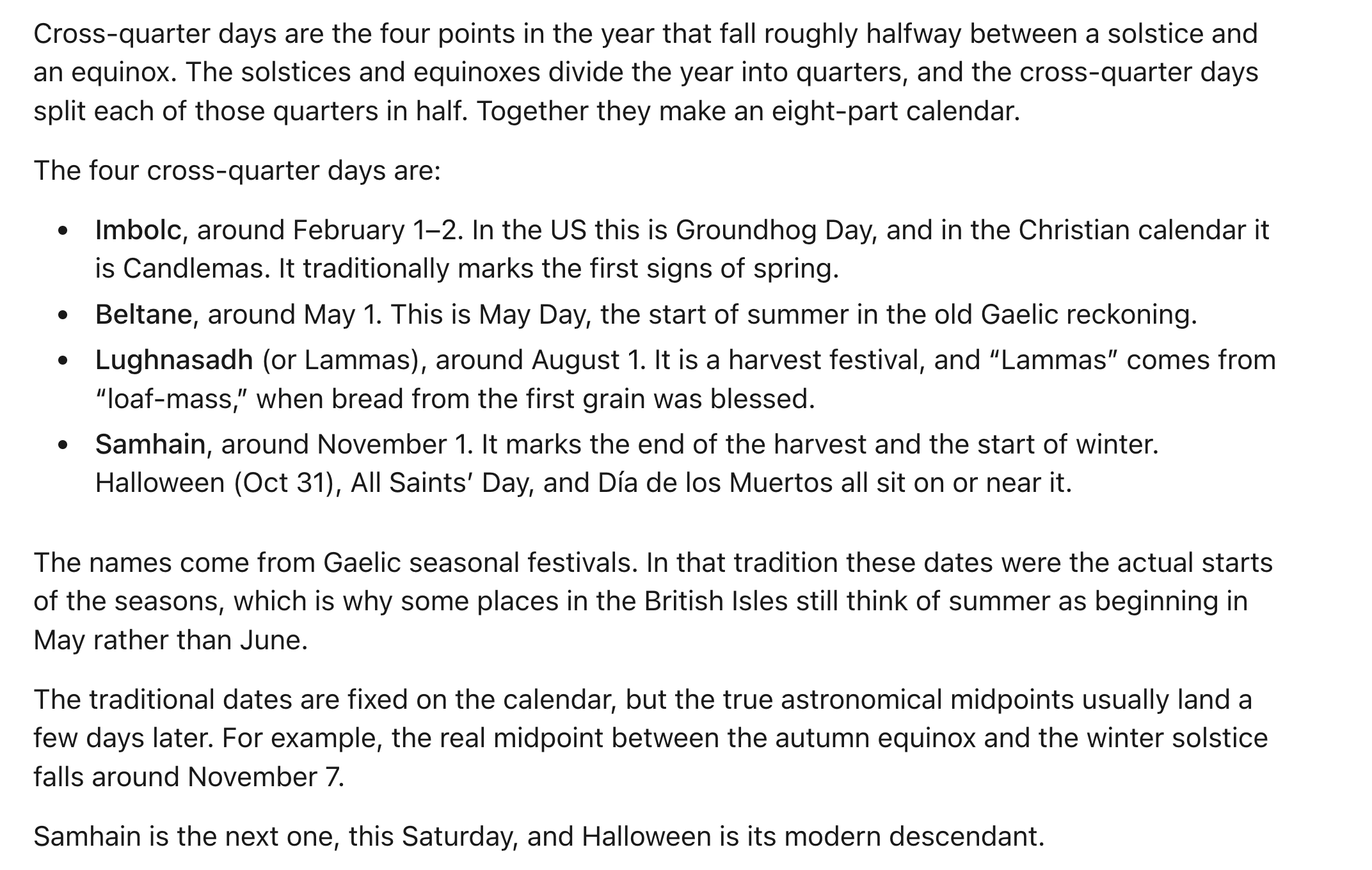
Speaking of Scary Images -- Halloween is Cross Quarter Day
 Related Material from some recent OLLI courses
http://edu-observatory.org/olli/classes.html
Alan Lightman On Richard Feynman's Amazing Mind, Or How
"Hawking Radiation" Could Well Be "Feynman Radiation" (6min)
https://player.vimeo.com/video/104516539
sam.wormley@icloud.com