Mike Meetz and Sam Wormley team up to provide a lively
discussion with OLLI members about science in the news. A
deep understanding of science is not required to share and
discuss recent Science in the News. Past Classes.
⓵ Webb spots possible early-universe supernova just days after it happened
https://phys.org/news/2026-10-webb-early-universe-supernova-days.html
The James Webb Space Telescope, with its exceptional
infrared vision, has made it possible to detect over 200
potential supernova events with host galaxy redshifts out to
around 6. Beyond redshift 4 (when the universe's age was 1.5
billion years), most candidates have been observed only once
or a few times, and few have been caught within days of
exploding. At redshifts greater than 5, only one supernova
has been confirmed based on its spectra, and only because it
was gravitationally magnified up to 30 times by a galaxy
cluster.
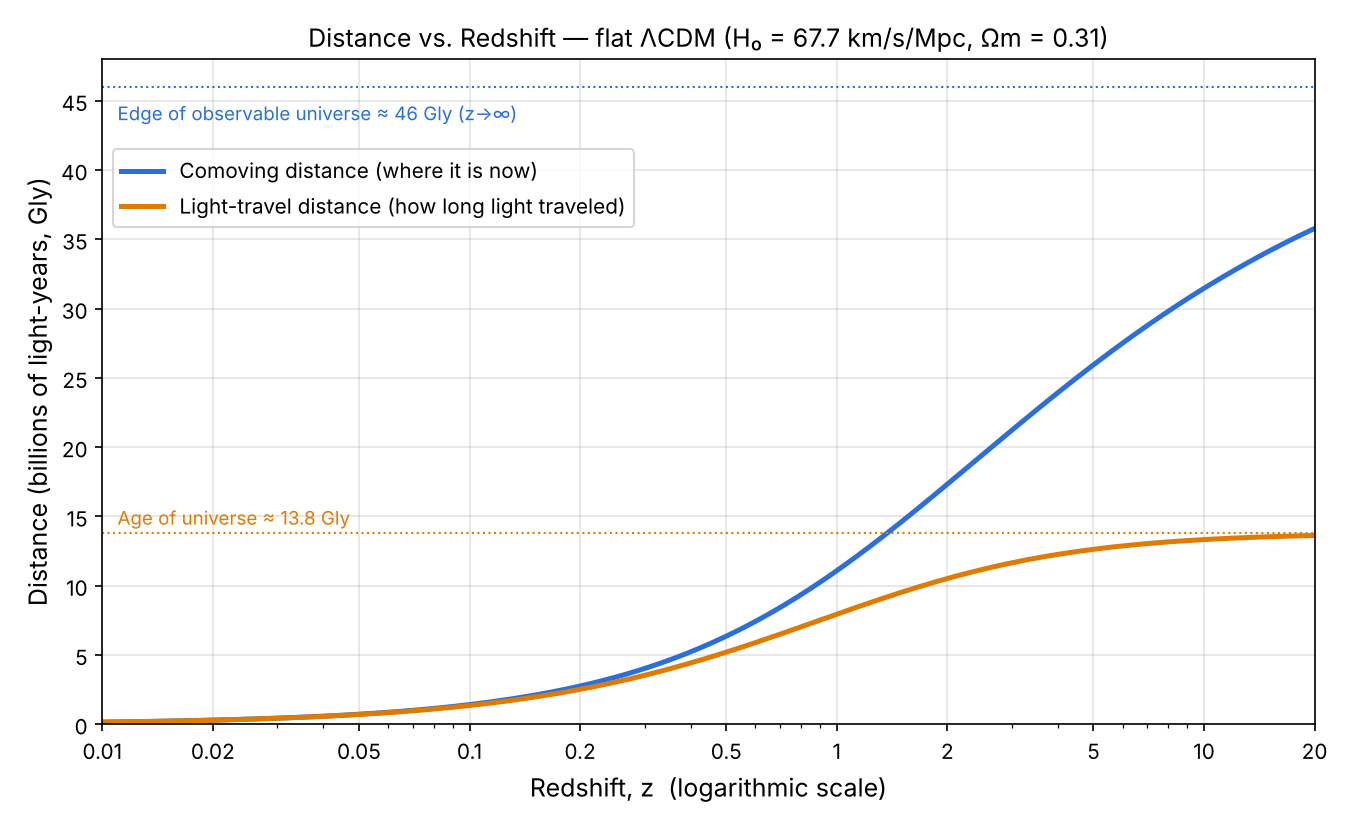 Comoving distance is how far away a galaxy is right now.
Because space keeps expanding while light travels, a galaxy
whose light has been on its way for 10 billion years is
today much farther than 10 billion light‑years away, about
16 billion at z ≈ 1.8.
Astronomers call it “comoving” because it uses a coordinate
grid that stretches along with the universe. For today, it
equals the actual physical distance. That’s why it’s the
natural measure of “where things are now,” and why the
observable universe has a comoving radius of about 46
billion light‑years even though it’s only 13.8 billion years
old.
⓶ James Webb reveals a massive cosmic structure that challenges
our understanding of the Universe | ScienceDaily
https://www.sciencedaily.com/releases/2026/10/261012185021.htm
NASA's James Webb Space Telescope has revealed an ancient
galaxy cluster with an unexpectedly dense concentration of
dark matter, challenging theories about how the universe
developed. The discovery also uncovered a surprising
connection between scattered starlight and invisible dark
matter that could transform how astronomers study the early
cosmos.
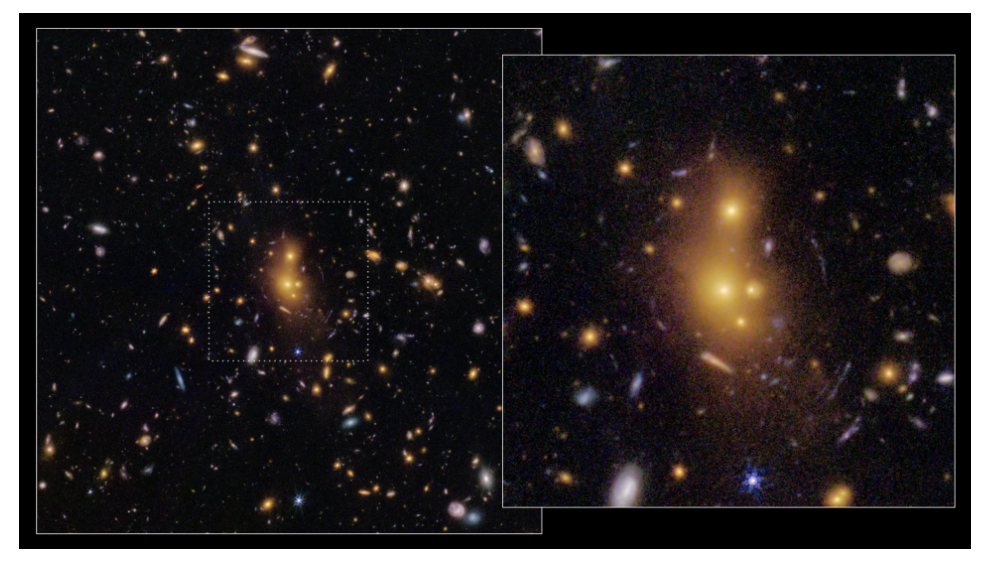 Located approximately 10.4 billion light-years from Earth,
XLSSC 122 stood out to astronomers because of its surprising
maturity. Although it existed during a period when galaxy
clusters were still assembling, it already displayed the
size and organized structure typically associated with
clusters in the modern universe.
Webb has now uncovered another remarkable feature. XLSSC 122
happens to lie directly in front of one or more galaxies
that are even farther away. The cluster's powerful gravity
bends and distorts the light traveling from those background
galaxies, creating a rare effect called strong gravitational
lensing. This fortunate alignment has given scientists an
exceptionally precise way to measure how mass is distributed
throughout the cluster.
⓷ OpenAI unleashes hundreds more math results upon a field
already in shock | Scientific American
https://www.scientificamerican.com/article/openai-unleashes-hundreds-more-math-results-upon-a-field-already-in-shock/
Math Revolution
Last week, OpenAI dropped AI-generated solutions to 372
important open math problems. This so-called “slop drop”
landed on a mathematical community that’s already drowning
in a deluge of LLM-written math they don’t yet understand.
And mathematicians are freaking out. They will need years to
make sense of these AI proofs (and without ever having
access to OpenAI’s model). On top of that, mathematicians
are grappling with rapid changes to their field—ones they
have no control of.
Biggest AI revelations:
• Progress on the Reimann hypothesis: Some call the Riemann
hypothesis the scariest problem in math. It centers on a
special, complicated equation called the Riemann zeta
function—specifically, which numbers you can put into this
function to make it come out to zero. OpenAI’s drop contains
major results about where these “zeros” don’t lie—a huge
step toward the holy grail of proving the hypothesis itself.
• The Kakeya conjecture: Imagine you have to slide a piece
of chalk around on a tablet so that it points in every
direction, while covering as little of the tablet with chalk
as possible. This summer, a mathematician won a Fields Medal
for solving the three-dimensional version of the problem.
OpenAI just dropped the solution in four dimensions.
• Computer science: The AI also improved some of the most
important algorithms in computing, including those that
underpin AI itself. This includes how to multiply integers
and matrices, as well as the so-called “fast Fourier
transform.”
What this means:
About a year ago, a bunch of AI companies decided that math
is a great way to prove to their investors that they’re
marching toward superintelligence. So they ate up all the
proofs and poached all the mathematicians they could. Now,
in a matter of months, they’ve successfully made humanity’s
oldest academic discipline unrecognizable. Things reached a
fever pitch a month ago, when OpenAI solved one of the
biggest problems in math—with rumors suggesting they’d
stolen others’ work to do so. A closer look has since
revealed that those rumors may have been overblown, and that
AI exploited a loophole in the wording of the problem,
rather than solving it in the way mathematicians hoped.
⓸ Al's taste skills move up self-improvement timeline
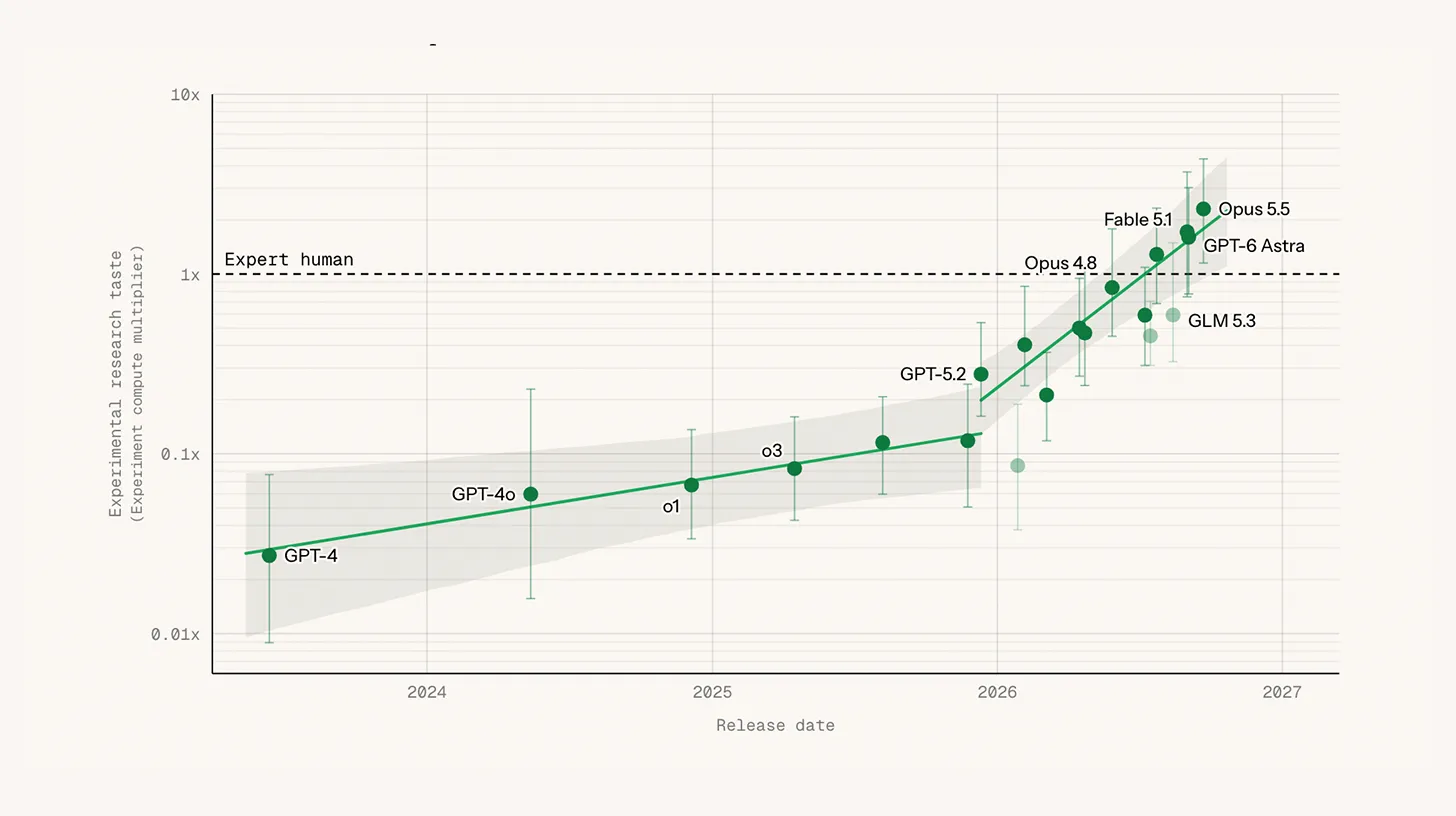 Image source: Anthropic
The Rundown: Anthropic co-founder Jack Clark just moved up
his projection for when AI could fully improve itself
(recursive self-improvement) to 2027 from 2028, pointing in
part to a new test that tracks how quickly AI’s research
instincts are improving.
The details:
• P-Zero Research’s TasteVal test gives models eight
AI-building problems to plan experiments for, while a
separate coding agent handles the actual work.
• Anthropic’s Opus 5.5 led the field, running about 30x
cheaper per attempt than 24 human experts who previously
worked at OpenAI, Google DeepMind, and more.
• Back in May, Clark put just 30% odds on fully automated
AI research in 2027, saying the work needed creative
leaps models hadn’t clearly shown.
• Anthropic’s engineers also wrote today that “coding is
no longer the bottleneck” at the company, with daily
merges up over 10x since May as Claude writes more.
Why it matters:
OpenAI has been very open about its goal of a fully
automated AI researcher, and Anthropic’s leaders keep
banging the drum that self-improving AI is getting closer to
reality. With that step seen as the ultimate accelerant for
AI progress, as fast as things are moving now, the real
speedup may not have even started yet.
⓹ The ‘Kelvin wave’ hitting California is a potent warning
about sea-level rise | Scientific American
https://www.scientificamerican.com/article/the-kelvin-wave-hitting-california-is-a-potent-warning-about-sea-level-rise/
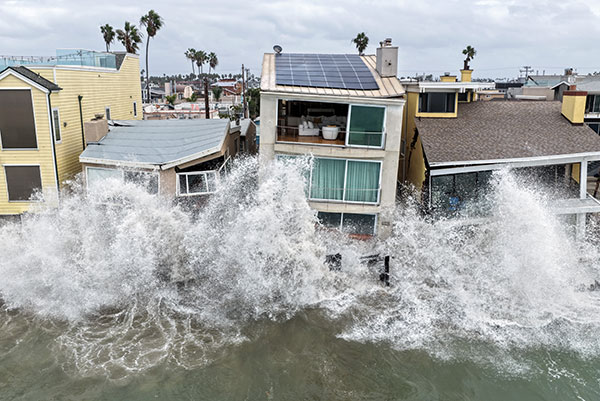 For the second time ever, US national forecasters issued a
tropical storm watch for Southern California as Tropical
Storm Rachel, an emerging El Niño and a Kelvin wave
compounded conditions in the region. (Mario Tama/Getty)
Kelvin wave offers glimpse of the future
A huge surge of water known as a Kelvin wave is showing what
sea-level rise, driven by climate change, could do to the
West Coast of North America. This type of underwater wave,
named after polymath Lord Kelvin (of absolute temperature
scale fame), originated at the Equator as a normal part of
the El Niño weather event — and it’s not the first, and
won’t be the last, this year. But, combined with high tides
and record-breaking warm water, this wave could cause sea
levels up to 60 centimetres (2 feet) higher than normal in
California, says climate scientist Daniel Swain.
Kelvin waves are large-scale ocean or atmospheric waves
trapped against a boundary, either a coastline or the
equator, where the Coriolis force is balanced by a pressure
gradient. The flow runs only parallel to the boundary, and
the wave’s amplitude decays exponentially away from it over
the Rossby radius of deformation.
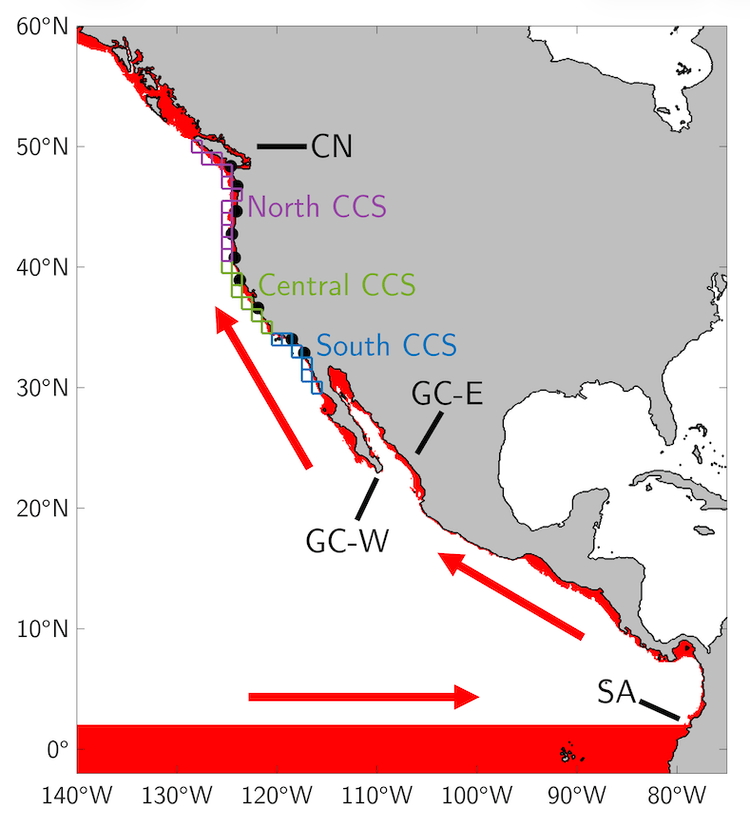 They travel in one direction only: coastal Kelvin waves keep
the coast on their right in the Northern Hemisphere, and
equatorial Kelvin waves always move eastward. They are
non-dispersive and travel at the shallow-water speed √(gH),
which is about 200 m/s for full-depth ocean waves and about
2–3 m/s for internal waves on the thermocline. They carry
ocean tides around basins and move warm-water anomalies
across the Pacific during El Niño.
⓺ It’s leaf-peeping season. Has this year’s extreme weather
hurt fall foliage?
https://www.scientificamerican.com/article/how-a-year-of-extreme-weather-and-a-super-el-nino-will-affect-fall-foliage/
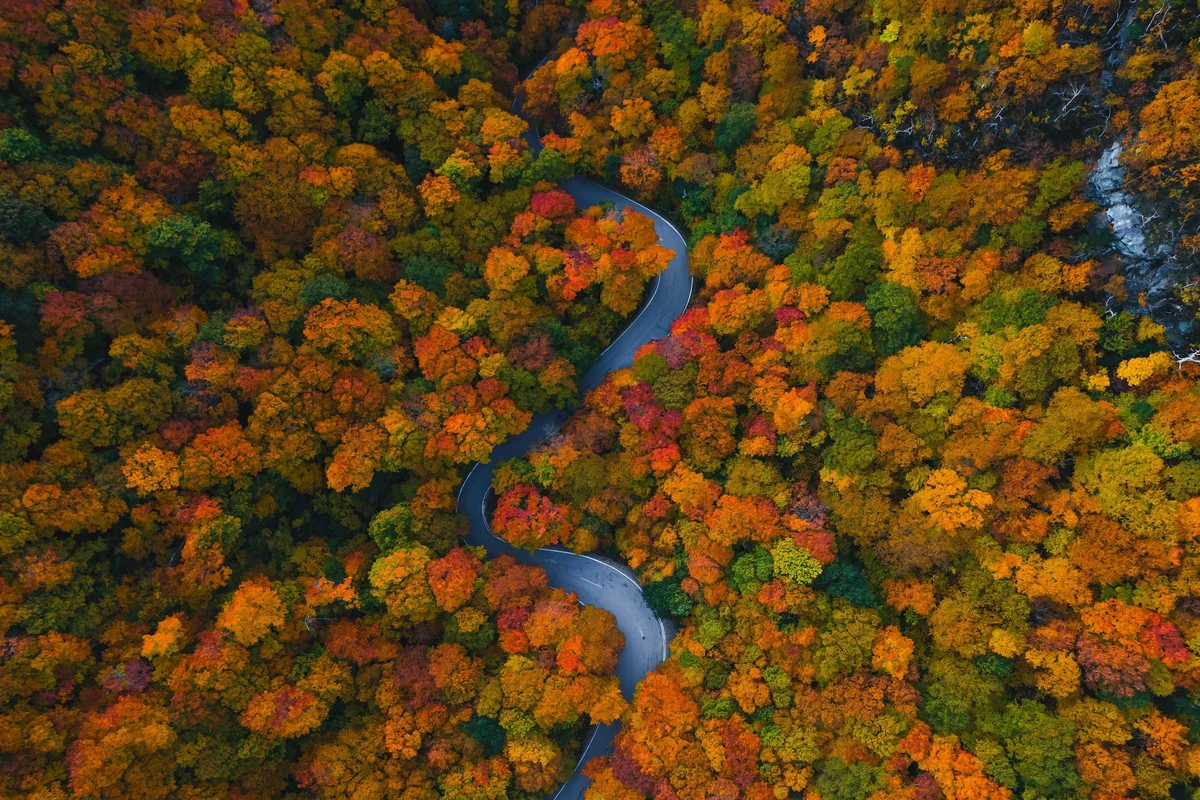 When summer turns to fall, trees get less sunlight, and they
slowly stop photosynthesizing to conserve water and
nutrients for the winter. At the same time, many trees suck
up chlorophyll from their leaves, revealing yellow shades.
(Chlorophyll creates the green pigment in leaves and holds
lots of valuable nutrients.) Some trees, such as maples,
also produce new, red pigments called anthocyanins in the
fall that protect them as they’re absorbing nutrients.
This whole process is designed to conserve as much
chlorophyll as possible, says Christy Rollinson, a forest
ecologist at the Morton Arboretum in Illinois. “Green is
really expensive—not just in my wallet but in the tree’s
wallet as well,” she says. “All of these different colors
are related to the tree trying to protect the green.”
As the climate warms, it can cause trees to extend their
growing season, and warm evenings don’t trap fall colors in
the leaves as well as colder ones, meaning later and less
vibrant changes to foliage. Extreme weather events, such as
drought or heavy rainfall, also stress trees and can trigger
them to rapidly protect themselves by more rapidly pulling
in the chlorophyll from their leaves, dulling fall colors.
Just as leaves that fall from different trees have distinct
shapes and hues of crimson or gold, tree species vary in how
susceptible they are to weather. Sugar maples, a “superstar”
of New England leaf peeping, are extremely sensitive to
temperature and precipitation, Finton says. Oak trees, on
the other hand, are more tolerant. But there’s a lot that
scientists still don’t understand about how different trees
are affected.
Related Material from some recent OLLI courses
http://edu-observatory.org/olli/classes.html
Alan Lightman On Richard Feynman's Amazing Mind, Or How
"Hawking Radiation" Could Well Be "Feynman Radiation" (6min)
https://player.vimeo.com/video/104516539
sam.wormley@icloud.com