MCC PHS 142 M01 Astronomy Homework Ch.8-9
Adj Prof Astronomy: Sam Wormley <sam.wormley@gmail.com>
Web: edu-observatory.org/eo/mcc.html
Background Material
Textbook - Read Chapters 8-9
Textbook - http://highered.mcgraw-hill.com/sites/0073512184/student_view0/chapter8/
Textbook - http://highered.mcgraw-hill.com/sites/0073512184/student_view0/chapter9/
(take the Multiple Choice Quiz for for each chapter)
Web - http://www.wimp.com/breathtakingfootage/
Web - http://edu-observatory.org/eo/earth.html
Web - http://edu-observatory.org/eo/moon.html
Web - http://edu-observatory.org/eo/eclipses.html
Web - http://edu-observatory.org/eo/telescopes.html
Web - http://co-ops.nos.noaa.gov/restles1.html
Web - http://en.wikipedia.org/wiki/Aberration_of_light
Web - http://wallres.saiswa.com/bg/saiyine/-/22-Apollo-11-LM-approaches-CSM-for-docking.jpg
Web - http://antwrp.gsfc.nasa.gov/apod/
Web - http://moonpans.com/prints/Apollo_11.jpg
The Earth in Perspective
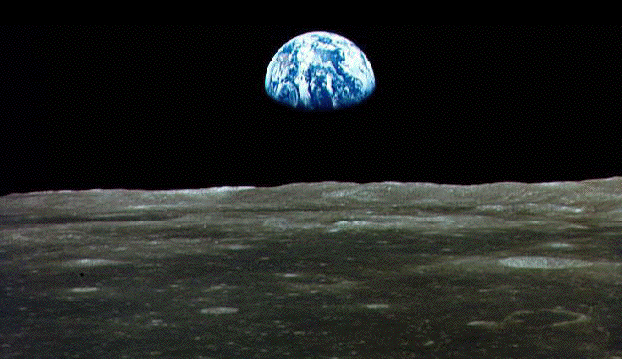 There is a nice reproduction of this EarthRise image on page 184 of
your textbook. Galileo, Johannas Kepler and Isaac Newton changed our
view of the Universe forever. They showed that we were no longer at the
center of everything.
Just as profound, is this image of the Earth rising above the Moon's
surface as the Apollo 8 Astronauts came around the Moon. From our
perspective on Earth, our planet appears to be big and sturdy with an
endless ocean of air. From space, astronauts often get the impression
that the Earth is small with a thin, fragile layer of atmosphere. And it
is! That little blue marble is us. We had better learn how to get along
with each other, and how to take care of our planet.
Homework Problems
Note the answers to the odd (Conceptual Questions, Problems and
Figure-Based Questions) are in the back of your textbook. It is
strongly suggested that you do some of those in every chapter so you
have immediate feedback as how well you are understanding the material.
There are online multiple choice quizzes for each chapter of your
textbook. Goto http://www.mhhe.com/fix then click on
Your book
Student Edition
Choose a chapter
Multiple Choice Quiz
You are expected to do all of your own homework. Statistical patterns
showing copying or collaboration will result in no credit for the
homework assignment for all participants involved. The Code of Academic
Conduct for Iowa Valley Community College District is found in the
Student Handbook.
Physical Science classes require the use of mathematics. If you don't
know algebra, you sould NOT be taking this class. If you need to review,
look at Introduction to Algebra
http://www.math.armstrong.edu/MathTutorial/
WolframAlpha is way faster than a scientific calculator.
http://www.wolframalpha.com
There is little excuse for turning homework in late. You have a whole
week between classes to read the chapters and do the homework. Homework
one week late - half credit. Two or more weeks late - no credit. Do the
homework during the week, not in class! You got homework questions,
email me 24/7. sam.wormley@gmail.com Even if you don't have a homework
question, email me anyway!
Problem 1:
The "best" telescope is the one that you will use the most.
There are many tradeoffs: cost, quality, stability, satifaction,
portability, ease of use, etc.
There is a nice reproduction of this EarthRise image on page 184 of
your textbook. Galileo, Johannas Kepler and Isaac Newton changed our
view of the Universe forever. They showed that we were no longer at the
center of everything.
Just as profound, is this image of the Earth rising above the Moon's
surface as the Apollo 8 Astronauts came around the Moon. From our
perspective on Earth, our planet appears to be big and sturdy with an
endless ocean of air. From space, astronauts often get the impression
that the Earth is small with a thin, fragile layer of atmosphere. And it
is! That little blue marble is us. We had better learn how to get along
with each other, and how to take care of our planet.
Homework Problems
Note the answers to the odd (Conceptual Questions, Problems and
Figure-Based Questions) are in the back of your textbook. It is
strongly suggested that you do some of those in every chapter so you
have immediate feedback as how well you are understanding the material.
There are online multiple choice quizzes for each chapter of your
textbook. Goto http://www.mhhe.com/fix then click on
Your book
Student Edition
Choose a chapter
Multiple Choice Quiz
You are expected to do all of your own homework. Statistical patterns
showing copying or collaboration will result in no credit for the
homework assignment for all participants involved. The Code of Academic
Conduct for Iowa Valley Community College District is found in the
Student Handbook.
Physical Science classes require the use of mathematics. If you don't
know algebra, you sould NOT be taking this class. If you need to review,
look at Introduction to Algebra
http://www.math.armstrong.edu/MathTutorial/
WolframAlpha is way faster than a scientific calculator.
http://www.wolframalpha.com
There is little excuse for turning homework in late. You have a whole
week between classes to read the chapters and do the homework. Homework
one week late - half credit. Two or more weeks late - no credit. Do the
homework during the week, not in class! You got homework questions,
email me 24/7. sam.wormley@gmail.com Even if you don't have a homework
question, email me anyway!
Problem 1:
The "best" telescope is the one that you will use the most.
There are many tradeoffs: cost, quality, stability, satifaction,
portability, ease of use, etc.
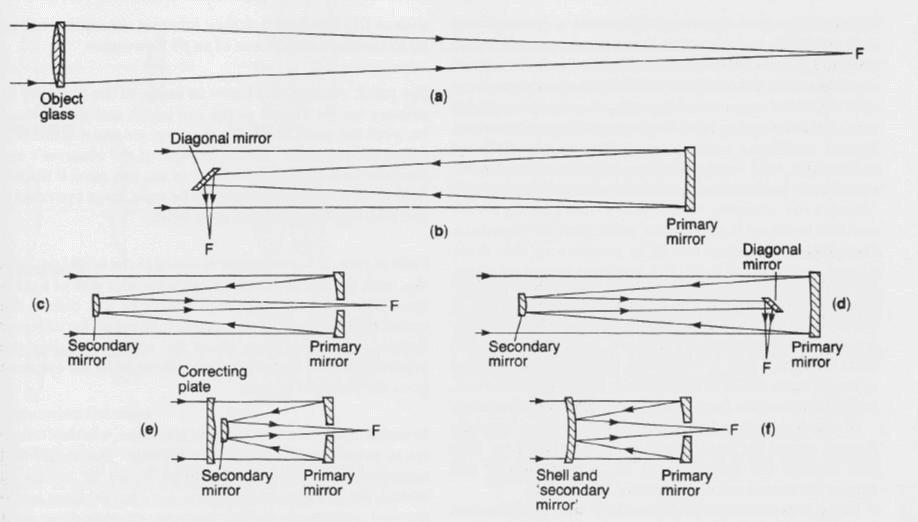 There are three basic types of telescopes -- Refractors (a), Newtonian
reflectors (b,c,d), and Catadioptrics (e,f). All these designs have the
same purpose, to collect light and bring it to a point of focus so it
can be magnified and examined with an eyepiece, but each design does it
differently. All designs can perform satisfactorily if properly and
responsibly manufactured and all have their own special virtues.
Advice for First Time Telescope Buyers
http://www.rocketroberts.com/astro/first.htm
http://findascope.com/
Support from Celestron [Telescopes]
http://www.celestron.com/c3/support3/
The magnification is simply the focal length of the telescope divided
by the focal length of the eyepiece.
Magnification = Telescopes F.L. / Eyepiece F.L.
For example, an 25 mm eyepiece with 1040 mm focal length telescope
provides a magnification of 1040 mm/25 mm = 41.6x. So if you were
looking at the moon, it would appear about 42 times bigger. Why is it
seldom practical to use a 4mm or smaller focal length eyepiece with a
telescope having a focal length of 700 mm or longer?
Problem 2:
Lets say you wanted to buy a nice eyepiece good for hunting comets. A
good choice might be one with not too much magnifications, say 20x.
Calculate what focal length you would need to get 20x with this 1040 mm
focal length telescope.
Problem 3:
Two proofs of the Earth's rotation are shown in Figure 8.4 (the
Foucault pendulum) and Figure 8.6 (the Coriolis effect).
The Earth also orbits our sun. The "aberration of starlight" is omitted
from many introductory textbooks, but our author has included it as the
very first proof that the Earth actually moves about the Sun.
See: http://en.wikipedia.org/wiki/Aberration_of_light
There are three basic types of telescopes -- Refractors (a), Newtonian
reflectors (b,c,d), and Catadioptrics (e,f). All these designs have the
same purpose, to collect light and bring it to a point of focus so it
can be magnified and examined with an eyepiece, but each design does it
differently. All designs can perform satisfactorily if properly and
responsibly manufactured and all have their own special virtues.
Advice for First Time Telescope Buyers
http://www.rocketroberts.com/astro/first.htm
http://findascope.com/
Support from Celestron [Telescopes]
http://www.celestron.com/c3/support3/
The magnification is simply the focal length of the telescope divided
by the focal length of the eyepiece.
Magnification = Telescopes F.L. / Eyepiece F.L.
For example, an 25 mm eyepiece with 1040 mm focal length telescope
provides a magnification of 1040 mm/25 mm = 41.6x. So if you were
looking at the moon, it would appear about 42 times bigger. Why is it
seldom practical to use a 4mm or smaller focal length eyepiece with a
telescope having a focal length of 700 mm or longer?
Problem 2:
Lets say you wanted to buy a nice eyepiece good for hunting comets. A
good choice might be one with not too much magnifications, say 20x.
Calculate what focal length you would need to get 20x with this 1040 mm
focal length telescope.
Problem 3:
Two proofs of the Earth's rotation are shown in Figure 8.4 (the
Foucault pendulum) and Figure 8.6 (the Coriolis effect).
The Earth also orbits our sun. The "aberration of starlight" is omitted
from many introductory textbooks, but our author has included it as the
very first proof that the Earth actually moves about the Sun.
See: http://en.wikipedia.org/wiki/Aberration_of_light
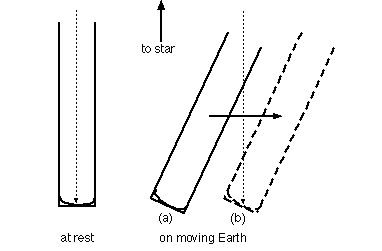 The aberration of light was discovered and later explained by the third
Astronomer Royal, James Bradley, in 1725, who attributed it to the
finite speed of light and the motion of Earth in its orbit around the
Sun.
Because of aberration, telescopes have to slightly shift their pointing
angles to correct for the aberration of starlight. What do you think
would happen to the size of the shift due to aberration if the speed of
light were ten times slower than it is?
Problem 4:
Using Figure 8.20, find the type of plate boundary that lies
between the Indian Australian and Antarctic plates. What kind of plate
boundary lies between the Eurasian plate and the Arabian plates?
Between the Indian Australian and the Eurasian plate?.
Problem 5:
What is the angular diameter of the Earth (in either degrees or arc
minutes) as seen from the Moon? Hint: The angular diameter of the
Moon as viewed from the Earth is about half a degree (30 minutes).
Since the Earth has a bigger diameter than the Moon, it's angular
diameter must appear larger. Hints: Drawing a picture often helps.
Essential data, such as the Earth's and Moon's diameters are found in
Appendix 6-7. Could the "small angle formula" be of use?
Problem 6:
Using Table 9.2, is there an eclipse season in which there were or will
be three eclipses in a row (every two weeks)?
Problem 7:
When does the First Quarter Moon rise compared to when the Sun rises
or sets? Hints: The Moon rises about 50 minutes later each night.
The Full Moon rises at sunset because it is on the opposite side of the
Earth from the Sun, Right?
Problem 8:
When does the New Moon rise?
Problem 9:
Using your star wheel (planisphere), determine what times the star
Vega sets and rises on your birthday?
Problem 10:
Using your star wheel (planisphere), determine how many hours and
minutes the star Vega is above the horizon on your birthday.
The aberration of light was discovered and later explained by the third
Astronomer Royal, James Bradley, in 1725, who attributed it to the
finite speed of light and the motion of Earth in its orbit around the
Sun.
Because of aberration, telescopes have to slightly shift their pointing
angles to correct for the aberration of starlight. What do you think
would happen to the size of the shift due to aberration if the speed of
light were ten times slower than it is?
Problem 4:
Using Figure 8.20, find the type of plate boundary that lies
between the Indian Australian and Antarctic plates. What kind of plate
boundary lies between the Eurasian plate and the Arabian plates?
Between the Indian Australian and the Eurasian plate?.
Problem 5:
What is the angular diameter of the Earth (in either degrees or arc
minutes) as seen from the Moon? Hint: The angular diameter of the
Moon as viewed from the Earth is about half a degree (30 minutes).
Since the Earth has a bigger diameter than the Moon, it's angular
diameter must appear larger. Hints: Drawing a picture often helps.
Essential data, such as the Earth's and Moon's diameters are found in
Appendix 6-7. Could the "small angle formula" be of use?
Problem 6:
Using Table 9.2, is there an eclipse season in which there were or will
be three eclipses in a row (every two weeks)?
Problem 7:
When does the First Quarter Moon rise compared to when the Sun rises
or sets? Hints: The Moon rises about 50 minutes later each night.
The Full Moon rises at sunset because it is on the opposite side of the
Earth from the Sun, Right?
Problem 8:
When does the New Moon rise?
Problem 9:
Using your star wheel (planisphere), determine what times the star
Vega sets and rises on your birthday?
Problem 10:
Using your star wheel (planisphere), determine how many hours and
minutes the star Vega is above the horizon on your birthday.